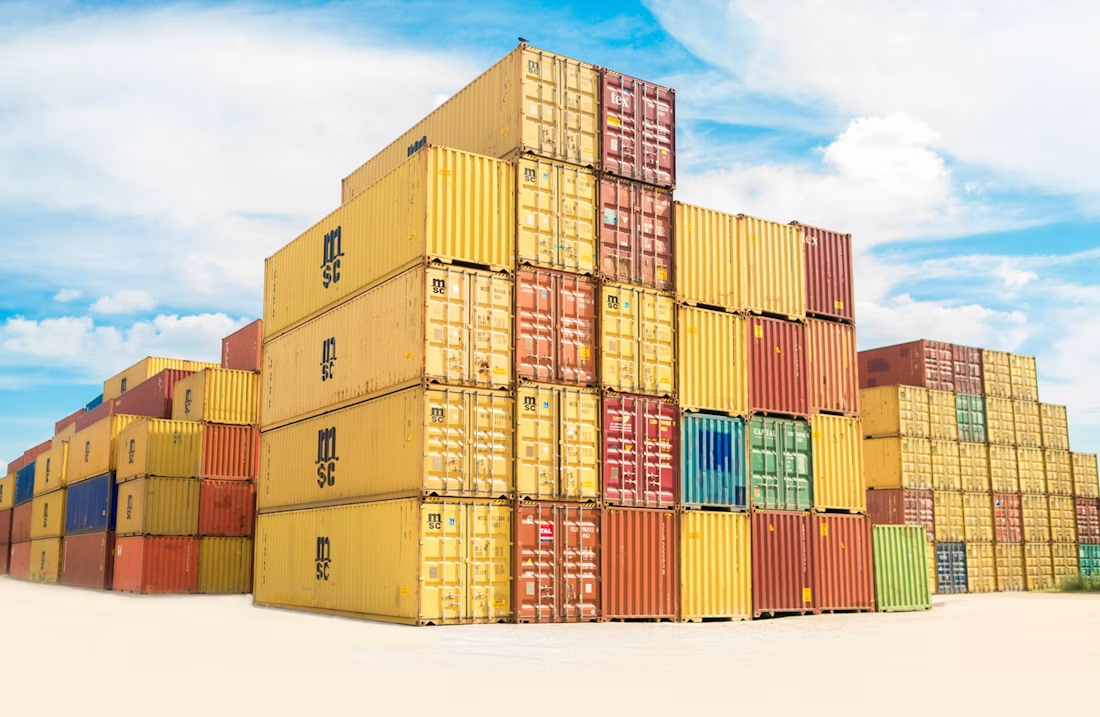
Project cargo, refrigerated, hazardous and out-of-gauge shipments need engineered solutions — not a checkbox on a quote form. Our specialists own these moves end-to-end, from route survey to final lift. 20+ years of cargo that doesn't fit the mould.
A transformer that weighs 90 tonnes. A reefer of vaccines that fails if it drifts two degrees. A class-3 flammable that needs IMDG paperwork before it touches a quay. A turbine blade that overhangs the trailer by four metres. None of these move on a standard rate card — they need a specialist who has done it before, because the cost of getting it wrong is a damaged asset, a rejected shipment, or a detained vessel.
We run four specialist desks: project & heavy-lift, reefer cold chain, dangerous goods, and out-of-gauge breakbulk. Each is owned by people who have spent years on exactly that cargo — engineering a lift plan, verifying a set-point, classifying a UN number, designing a lashing scheme. Not a generalist reading off a checklist.
And because we also run the freight, customs and warehousing around it, the specialty move doesn't sit in a silo. The route survey informs the booking; the DG declaration is filed with the customs entry; the reefer plug-in is arranged at the bonded yard. One team owns the whole chain — so the hard part doesn't fall between two vendors.
Why BCOLogix for Specialized Cargo
Three reasons specialty cargo belongs with a specialist.
A standard forwarder quotes specialty cargo off a calculator and hopes. We engineer it. The difference shows up at the lift, at the temperature log, and at the customs gate — exactly where a generic booking falls apart.
01
Engineered, not estimated
Heavy-lift and out-of-gauge moves start with a route survey and a lift study, not a guess. We model the crane geometry, axle loads, bridge clearances and securing scheme before the cargo leaves the factory — so the first time the plan is tested isn't on a live quay with a 90-tonne piece in the air.
Route survey · lift & lashing plan
02
An unbroken cold chain
A reefer move is only as good as its weakest link — the gap at the port, the plug-out during trucking, the set-point nobody verified. We verify the set-point at stuffing, supply GenSet power for every off-power leg, and log temperature end-to-end so you get a continuous chart, not a shrug, if a buyer queries the cold chain.
Set-point verified · GenSet · data-logged
03
Dangerous goods by the book
One wrong declaration and a vessel detains your container, or a carrier blacklists your account. Our IMDG and IATA DGR-certified handlers review the MSDS, classify the UN number, specify UN-approved packaging and segregation, and file the DG declaration with the booking — so the cargo is accepted first time, not bounced at the terminal.
IMDG & IATA DGR certified
Service Lines
Four specialist desks for cargo that breaks the mould.
Project & heavy-lift, reefer cold chain, IMDG/IATA dangerous goods and out-of-gauge breakbulk — each owned by people who have handled exactly that cargo for years. Engineered moves, not checkbox bookings.
01
Heavy lift · Engineered
PRJBBLK
Project Cargo
Wind turbines, transformers, plant equipment and infrastructure moves — engineered transport from factory floor to project site. The lift is planned before the cargo is built, not improvised on the quay.
Route survey & civil works study — bridge clearances, axle loads, road reinforcement
Temperature-controlled reefer containers and end-to-end cold-chain integrity for seafood, pharma, fresh produce and dairy. The set-point is verified and logged, not assumed.
40' HRF reefers, set-point verified — confirmed at stuffing, not left to chance
GenSet supply for off-power transit — power on every trucking and yard-dwell leg
Data-logger & cold-chain audit — a continuous temperature chart on delivery
Pharma & perishable protocols — GDP-aligned handling for sensitive loads
Class 2-9 dangerous goods by sea and air, with full IMDG/IATA documentation and certified packing. The declaration is filed with the booking, so the cargo is accepted first time — not detained at the terminal.
DG declaration & MSDS review — UN number and packing group confirmed upfront
Out-of-gauge moves on flat-rack, open-top and breakbulk vessels for cargo that won't fit a standard 40ft container. The securing scheme is designed to class-society standards, not improvised dockside.
FR & OT booking with all major carriers — over-dimension surcharges negotiated upfront
Lashing & securing design — engineered to class-society and carrier standards
Breakbulk & ro-ro options — MPP vessels and roll-on/roll-off for wheeled units
Port special-handling & permits — heavy-lift cranes and clearances arranged at each port
A move that spans several of these? A refrigerated DG shipment, an over-gauge piece on a chartered vessel — our specialists coordinate across desks so the plan holds end-to-end. One bill, one owner.
How We Work
From survey to safe delivery in four steps.
One named specialist owns your move from feasibility study to final lift — no inbox tag.
01
Survey & Engineer
We assess the cargo and the route — dimensions, weight, temperature or DG class — and produce the plan: lift study, lashing scheme, set-point spec or UN classification, whatever the move demands.
Route survey · engineered plan
02
Permit & Prepare
Special permits, escort and route clearances arranged; equipment booked — flat-rack, open-top, reefer with GenSet, SPMT or crane. DG declaration filed, UN-spec packaging and segregation confirmed.
Permits · equipment · DG docs
03
Lift & Move
The move executed to plan — supervised lift, secured load, monitored transit. Cold chain logged, oversized loads escorted, DG segregation maintained. Our specialist is on-site or on-call throughout.
Supervised lift · monitored transit
04
Deliver & Sign-off
Final placement at site, set-down supervised, condition documented with photos. Cold-chain log and DG paperwork handed over, delivery signed off — a clean record for your insurer, buyer or auditor.
Condition report · full documentation
Specialized Cargo FAQ
Questions before you book.
The most common things shippers ask us about heavy-lift, reefer cold chain, dangerous goods and out-of-gauge moves. If yours isn't here, the specialist desk responds in 2 business hours.
Need a custom answer?
Talk to a project-cargo or DG specialist on our team.
What counts as "project cargo" and when do I need it?
Project cargo is any move that can't be handled as routine containerized freight — typically because of weight, dimensions, value or complexity. Think transformers, generators, wind-turbine components, plant modules, mining equipment, or a full factory relocation. The signals you need it: the piece exceeds standard container or trailer limits, requires a crane or SPMT to handle, needs a route survey for bridge/road clearance, or moves as a coordinated multi-piece campaign. If you're unsure, send us the dimensions and weight and we'll tell you whether it's standard or project.
How do you keep a reefer cold chain intact end-to-end?
The cold chain breaks at the handoffs, not in transit — the gap on the quay, the unplugged hour during trucking, the set-point nobody confirmed. We verify the temperature set-point at stuffing, supply GenSet power for every off-grid leg (trucking, yard dwell, gen-less terminals), and fit a data-logger that records the full journey. You receive a continuous temperature chart on delivery, so if a buyer or auditor queries the cold chain you have evidence, not assurances. Range handled is roughly −25 °C to +25 °C for seafood, pharma, fresh produce and dairy.
Which classes of dangerous goods can you handle?
We handle Classes 2 through 9 in-house by both sea (IMDG) and air (IATA DGR) — gases, flammable liquids and solids, oxidizers, toxic and corrosive substances, and miscellaneous dangerous goods. Class 1 (explosives) and Class 7 (radioactives) require specialized carriers and permits and we generally don't carry them. For everything we do handle, our certified team reviews the MSDS, confirms the UN number and packing group, specifies UN-approved packaging and segregation, and files the DG declaration with the booking so the cargo is accepted first time.
What does "out-of-gauge" mean and how is it shipped?
Out-of-gauge (OOG) cargo is anything that exceeds the internal dimensions of a standard container — too tall, too wide or too long to close the doors. It ships on a flat-rack (collapsible ends, load secured on the deck) or open-top (tarpaulin roof for over-height) container, or as true breakbulk on a multi-purpose or heavy-lift vessel when it won't sit on any container at all. The work is in the securing: we design the lashing and bracing scheme to class-society standards, calculate the over-dimension surcharges with the carrier, and arrange the special handling and permits at each port. Ro-ro is another option for wheeled or tracked units.
Do you provide cargo insurance for high-value specialty moves?
Yes. For project cargo, reefer and other high-value moves we strongly recommend all-risk marine cargo insurance, and we arrange it through our underwriters at the declared value. Specialty cargo carries specialty risk — a heavy-lift drop, a reefer breakdown, a DG incident — and standard carrier liability is limited by weight, not value, so it rarely covers the real exposure. We help you document condition before and after with photos, which protects any claim. Insurance is quoted as a transparent line item alongside the freight.
How long does a specialty move take to quote and plan?
It depends on complexity. A reefer or straightforward DG booking can be quoted within a day or two once we have the cargo details and MSDS. A heavy-lift or out-of-gauge project needs a route survey and lift study first — typically one to three weeks depending on the route, permit authorities and whether a site visit is required. The earlier you involve us the better: bringing the specialist in at the design or procurement stage, before the equipment is even built, often unlocks cheaper routing and avoids a piece that's simply too big to move economically. Send dimensions, weight and timeline and we'll scope the lead time on the first call.
Related Services
Often paired with specialized cargo.
A specialty move rarely travels alone — it needs the right freight mode, DG clearance and heavy-haul road legs around it. We coordinate all of it on one bill, so the engineered plan holds end-to-end.
Send us the dimensions.We'll engineer the move around them.
Share the cargo specs — weight, dimensions, temperature or DG class — and your timeline. We come back with a feasibility view, an engineered plan and a transparent quote — no obligation.