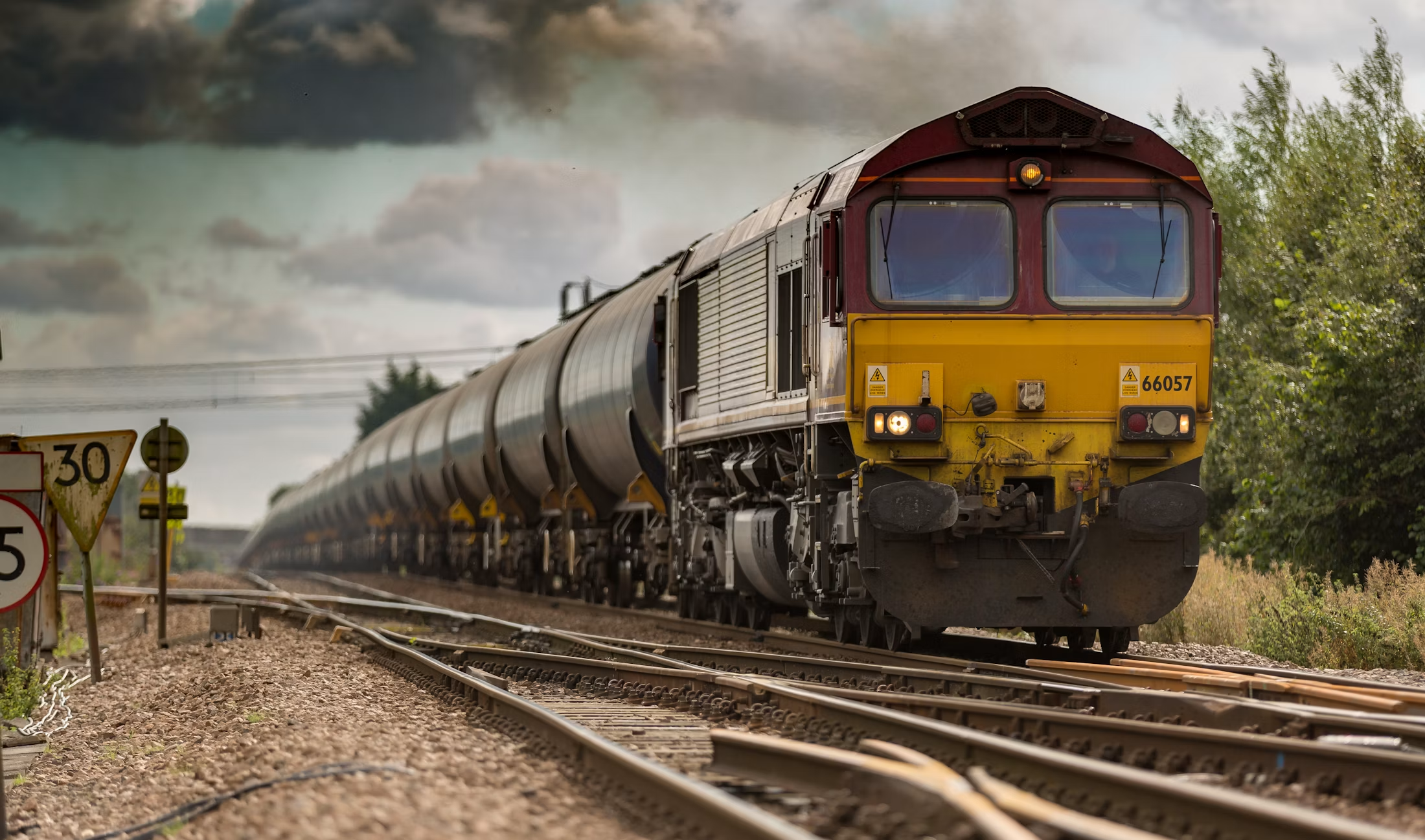
Block-train allocation, FCL and LCL rail across the China-Vietnam border and the Trans-Eurasian land bridge to Europe. Sea-comparable cost, half the transit, with disciplined gauge-change handling at every interchange.
For lanes between Asia and Europe, rail used to be the forgotten option. That changed. A container moved by rail from China to Germany now arrives in 15-25 days at a cost much closer to sea than to air — opening up a middle option that didn't exist before for time-sensitive cargo that can't justify air freight.
We book block-train allocation on the China-Vietnam corridor (Lao Cai, Dong Dang) and on the Trans-Eurasian land bridge (China-Kazakhstan-Russia-Belarus-Poland-Germany-Netherlands). FCL-Rail for full containers, LCL-Rail consolidation for partial loads, and multimodal sea-rail combinations when the math works better that way.
The hard part of rail isn't the train — it's the interchanges. Chinese, Russian and European networks run on different gauges, so every container has to be transferred at the border. We manage trans-shipment crews, customs at each border, and document hand-offs end-to-end so the cargo doesn't sit waiting.
Why BCOLogix for Rail
Three things that make or break a rail move.
Rail looks simple on a map. In practice, the difference between a 15-day arrival and a 35-day arrival comes down to who holds the train slot, how the gauge change is handled, and whether the multimodal legs were planned together.
01
Block-train allocation
We hold weekly block-train slots on the major Eurasian corridors — not just spot space. That means guaranteed allocation when capacity tightens, predictable transit windows, and direct relationships with the rail operators instead of brokered intermediaries.
Weekly slots · direct operator deals
02
Multimodal sea-rail
For many origins, the smartest move is sea to a Chinese port then rail onward to Europe — cheaper than full-rail, faster than full-sea. We model the cost-time trade and pick the right combination per shipment rather than defaulting to one mode.
Sea-rail combos · one bill
03
Gauge-change discipline
Rail moves fail at gauge changes — CN (1435mm), RU/KZ (1520mm) and EU (1435mm) require trans-shipment at Dostyk/Khorgos and Brest. We staff the interchanges, pre-clear customs at each border, and track each transfer so containers don't sit waiting on the wrong-gauge side.
Dostyk · Khorgos · Brest cleared
Service Modes
Rail mode for every cargo profile.
From full block-train allocation to LCL consolidation slots — including reefer-rail and flat-car options for oversize. Sea-rail combinations engineered when the math works better.
40'DC-RailFCL
40' rail container
Standard 40-foot dry container moved by rail — the workhorse for full-container Asia-EU.
Payload26.5 t
Volume67 m³
Transit15-22 d CN-EU
Block-TrainSlot
Block-train allocation
Pre-booked weekly slot on a dedicated freight train — guaranteed capacity, predictable transit.
Capacity41-50 TEU
Frequencyweekly
CorridorsCN ↔ EU
LCL-RailGroupage
LCL-Rail consolidation
Share a container by rail — your cargo consolidated with others on the same lane.
Min CBM1 m³
Departuresweekly
Best for2-15 m³ loads
FR/OT-RailOOG
Flat-car & open-top
Flat-rack and open-top rail wagons for machinery, project cargo and OOG dimensions.
Max length13.5 m
Max height2.9 m above floor
Permitsarranged inline
Reefer-RailCold Chain
Reefer rail container
Temperature-controlled 40-foot reefer with GenSet power on dedicated rail wagons.
Range-25°C to +25°C
Volume57 m³
Monitoring24/7 telemetry
Sea+RailMultimodal
Sea-rail combination
Ocean leg to a Chinese gateway port then rail onward — cheaper than rail-only, faster than sea-only.
Transit~25-35 d
GatewaysShanghai · Ningbo
Billingsingle house B/L
Need a specialty wagon? Tank-rail, hopper, double-stack and project-cargo flat cars arranged for non-standard cargo. DG by rail handled per RID regulations.
How We Work
From quote to arrival in four steps.
One named coordinator stays with you across every gauge change and border — no inbox tag.
01
Quote
Share origin, destination, weight and volume. We model sea-only, rail-only and sea-rail combinations side-by-side so you pick by cost-time, not by default.
4-hour SLA · cost-time comparison
02
Book Slot
We allocate your slot on the next departure, pre-clear customs at each border, and stage inland trucking on both ends so loading and discharge are ready.
Block-train slot confirmed
03
Ship & Transfer
Train tracking by milestone: origin departure, gauge-change interchanges (Dostyk/Khorgos, Brest), border clearances, EU terminal arrival.
Milestone alerts at every border
04
Arrive & Deliver
Discharge at the EU rail terminal (Duisburg, Łódź, Rotterdam), final-mile trucking to your DC, and digital POD captured on delivery.
EU terminal discharge · e-POD
Rail FAQ
Questions before you book.
The most common things shippers ask us about block trains, gauge changes, transit times and multimodal sea-rail. If yours isn't here, ops desk responds in 2 business hours.
Need a custom answer?
Talk to a rail freight specialist on our ops team.
Rail sits between sea (cheap, 35-45 days) and air (fast, 5-7 days). On CN-EU lanes, rail is roughly 15-22 days at 2-3× sea cost but a fraction of air. It's the right choice when sea is too slow for your inventory cycle and air is too expensive for your margin — typically mid-value goods, seasonal collections, replenishment shipments, or where ocean rates spike during peak.
What corridors do you serve by rail?
Two main flows. (1) CN-VN cross-border rail via Lao Cai and Dong Dang — daily container service for goods moving between southern China and Vietnam. (2) Trans-Eurasian land bridge: China to Europe via Kazakhstan, Russia, Belarus and Poland — weekly block trains from Yiwu, Chengdu, Xi'an and Chongqing to Duisburg, Hamburg, Łódź, Rotterdam and Madrid.
What is a gauge change and why does it matter?
Different countries use different track widths. China and Europe use 1435mm (standard gauge); Russia, Kazakhstan and Belarus use 1520mm (broad gauge). So every container has to be physically transferred between trains at the border interchange (Dostyk/Khorgos on the CN-KZ side, Brest on the BY-PL side). Done badly, this is where 3-5 days of delay creep in. We staff the interchanges and pre-clear customs so the transfer is clean.
How is rail freight tracked?
Rail tracking is by milestone rather than continuous GPS. You get notifications at origin departure, each border interchange (with customs status), each major intermediate hub, and EU terminal arrival. Reefer-rail adds 24/7 telemetry on temperature, humidity and door events. Container number searchable in our portal end-to-end.
Can you handle hazardous goods (DG) by rail?
Yes — DG by rail is regulated under RID (the rail equivalent of ADR/IMDG). Classes 2-6, 8 and 9 handled regularly with proper documentation and segregation. Class 1 (explosives) and Class 7 (radioactives) require operator-specific permits and longer lead time — possible, but not on every train. MSDS review included in booking.
What does multimodal sea-rail look like?
For shipments where origin is far from a rail terminal, the smartest move is often: short ocean leg to a Chinese gateway port (Shanghai, Ningbo, Qingdao), then rail to Europe. Total transit 25-35 days at ~70% of full-rail cost — meaningfully faster than full-sea, much cheaper than full-rail. We model both options on every quote so you can choose.
Related Services
Often paired with rail freight.
Most rail shipments need inland trucking on both ends and a backup mode for urgent units. We coordinate as a single team, on one bill, so handoffs don't fall through the cracks.