


The Bill of Lading Decoded: Master vs House, Original vs Telex Release
The bill of lading is receipt, contract and title to your goods all at once. Knowing which type you are holding decides who can collect the cargo, and when.
Read ArticleBefore you can book ocean freight intelligently, you need two things: a feel for the standard container types and the ability to calculate how much of one your cargo will fill. Both are simple arithmetic, but shippers who skip them end up paying for empty space or, worse, discovering at the warehouse that the goods do not fit.
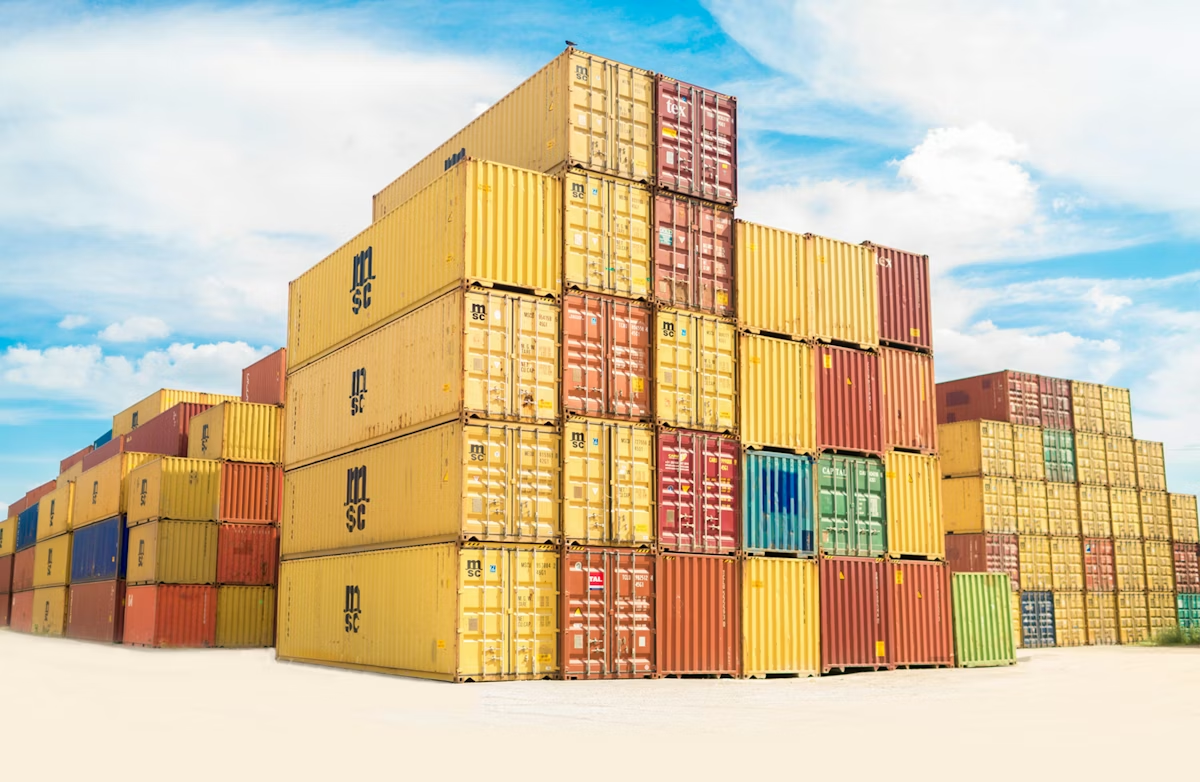
Three containers carry the overwhelming majority of world trade:
A key insight hides in those numbers: a 40ft holds twice the volume of a 20ft but not twice the weight. Heavy cargo "weighs out" a 20ft long before it fills; light cargo "cubes out" a 40HC long before it gets heavy.
When cargo does not fit a standard box, specialised equipment steps in: reefers for temperature control, open-top (OT) for over-height loads craned in from above, flat-rack (FR) for out-of-gauge and heavy machinery, tank containers for bulk liquids, and 45ft high-cubes for extra length. Each trades flexibility for a higher rate and tighter availability.
Cubic metres (CBM) is the volume of your cargo: length × width × height, all in metres. A carton measuring 60 × 40 × 30 cm is 0.6 × 0.4 × 0.3 = 0.072 CBM. Multiply by the number of cartons for the total. Always measure the outermost dimensions of the packed unit — including the pallet — because that is the space the carrier actually sells you.
Measure the pallet, not the product. Carriers charge for the space your packaging occupies, not the goods inside it.
Theoretical capacity is never usable capacity. After accounting for pallet footprints, stacking limits and load planning, plan on roughly 28–30 CBM in a 20ft, 56–60 CBM in a 40ft, and 68–72 CBM in a 40HC. Treat the headline figures as a ceiling, not a target.
Every booking is bounded by two limits at once — the cubic capacity of the box and its maximum payload. Dense goods such as tiles, liquids or machinery hit the weight limit first; bulky goods such as furniture or apparel hit the volume limit first. Plan against whichever you reach sooner, and remember the road leg: many countries cap the gross weight a truck may legally haul, which can be stricter than the container's own rating.
Whether it's a single LCL pallet or a chartered vessel, the conversation starts the same way — with a real person, on the phone or in your inbox.